
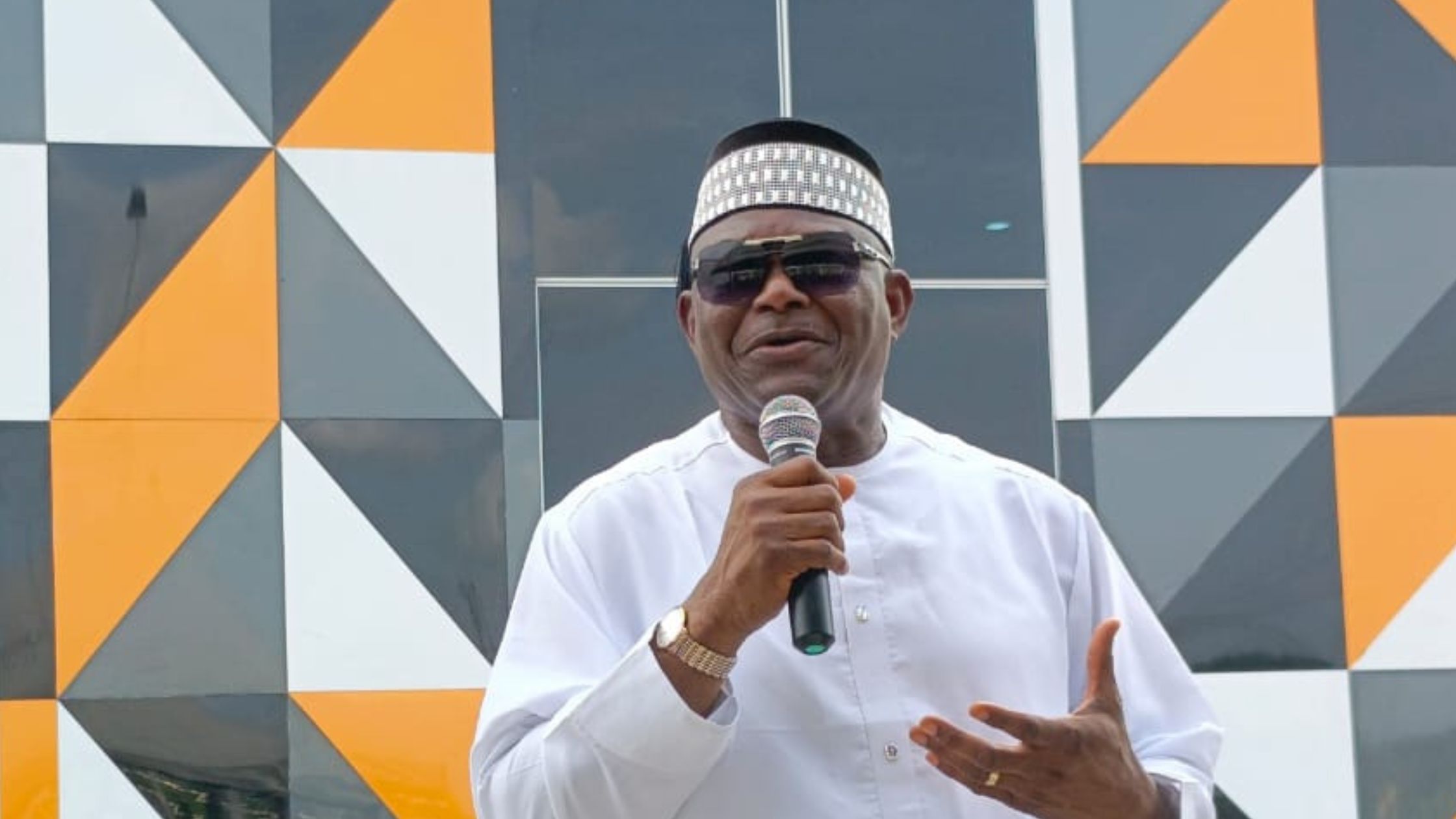
The legendary Prof. Pat Utomi today (June 16, 2024) posted the following tweet on X social platform:
“I watched the South African elections and wondered what Mahmoud Yakubu and INEC thought of it and of themselves. Then I watched Ramaphosa sign up on a government of National Unity and I wondered if those who captured power in Nigeria were watching. How do they benchmark. Now I am watching Kenya’s William Ruto on the world stage in Switzerland as the face of Africa. The political class of 1999 seem to have completed the humbling of Nigeria with the loss of a sense of shame as Nigeria takes a back seat to their self love”. As I read the tweet, it brought to my mind so vividly, a conversation I had with my senior brother, Chief (Barr.) Blessing Oghenekevwe Ohwavborua, JP of blessed memory, in my compound in Sapele, sometime in 2011.
That Saturday morning, our residences not being far apart, he walked over to my place to inform me of a telephone conversation he had late the previous night, with the then National Treasurer of the Peoples Democratic Party (PDP) of Nigeria, Chief Williams Makinde. According to him the National Treasurer of the PDP, a kinsman and a friend, had called him to advise him to stop further pursuit of his appeal on the conduct of the PDP primaries for the House of Representatives position for the Ethiope Federal Constituency, wherein my brother was a candidate. Earlier in the year, against my advice, my brother had completed application forms to vie for the House of Representative position under the platform of the PDP for the fourth time in a row. In advising him against the move, I had argued that the previous ones he participated in were anything but transparent, free and fair, and this would not be different. His winning argument then was that he had been assured by the leaders of the party in the Federal Constituency of which Chief Makinde was part, that it was his turn. So we can see that ‘emilokan’ preceded President Tinubu. Long story short, he and about nine others contested against the then incumbent, Hon. Emeyese who was my secondary school mate.
For every Saturday and Sunday of the four months that preceded the primaries, I went with my brother and his close supporters on courtesy calls, stakeholders engagements, campaigns, etc, to all the nooks and crannies of the two Local Government Areas (LGAs) that made up the Federal Constituency, wooing would be delegates. Almost all my savings as a civil servant were channeled to the funding of these movements. That was not the painful part. The painful part was, after securing the assurances of a greater chunk of the delegates in both Ethiope East and Ethiope West LGAs, camped them in hotels on the eve of the primaries, and successfully mobilized them to Oghara stadium, the venue of the primaries, while we were all anxiously waiting for the panel appointed to conduct the primaries to arrive, news came from Asaba that the event had been concluded, and that Hon. Emeyese had won the primaries. He was the only contestant that was absent on the field that day. My brother, just like most of the disappointed and frustrated contestants naturally filed petitions with evidences to support their claim that the primaries did not hold.
I recall vividly that the then National Legal Adviser to the PDP, Barr. Olusola Oke, a rare bred lawyer known for his outspokenness and forthrightness, whom I made acquaintance of when he was the Ondo State Representative on the Board of the Niger Delta Development Commission (NDDC), and Chief William Makinde, a major stakeholder from the constituency supported my brother’s petition to the extent that another panel was reconstituted. But before the panel could come for another run of the primaries, the then governor of Delta state waded into the matter, that as far as the Delta state PDP was concerned, the primaries had been concluded and a winner had been proclaimed. The Governor had spoken! The story from the grapevine then was, the then Chief of Staff to the then President invited Chief Makinde and advised him to stop fighting his Governor if he was interested in continuing in office as Treasurer. This however was unconfirmed.
My brother lived in that shock, frustration and disappointment for the next two years, a period that saw him lose interest in almost everything; lost his activism, advocacy, fun and courage. All he had left were his love for God and family, good nature and cool. Life almost became meaningless to him. He succumbed to the pressure of the frustration when he slumped in his car on November 28, and passed on 30th November 2013, another statistic of Nigerian politics. May his gentle soul continue to rest eternally in God’s bosom in Jesus name.
Back to the conversation that his telephone conversation with Chief Makinde provoked that Saturday morning in my compound. Obviously reeling in that frustration and disappointment, he said that the kind of politics we play in Nigeria would never support true greatness, because the politics itself was a lie. For one to go far in it, one had to be a liar or simply be dishonorable. That his failure to clinch the PDP ticket for the Ethiope Federal Constituency was solely because his refusal to yield to the lie or simply become dishonorable. He opined that the stark reality was that liars and dishonorable men cannot build a great nation. At this point, I reminded him that Nigeria was the giant of Africa. Don’t forget that this was 2011, Dr. Goodluck Jonathan was President, and Nigeria’s Gross Domestic Product (GDP) was 414.5 billion USD and growing by 5.3% annually, only second to South Africa with a GDP of 458.6 billion USD. He responded by saying that the reference to Nigeria as the giant of Africa in the 70s, 80s, 90s and the 2000s was lillusionary. In reality I couldn’t agree more, I only brought up the giant of Africa bit to stretch the argument further. I concluded that conversation by asserting that, the seeming greatness equated to the new found wealth that came with the discovery of the black gold – crude oil. The ingredients that sustain such wealth such as honesty, transparency, accountability, hard work, politics of meritocracy and rule of law were lacking, and that Nigeria’s greatness could only sustain if our politics changed. These are actually hallmarks of true democracy. Democracies across the world that have grown sustainable economies are rested on the above pivots. Examples are Singapore, Japan, United States of America, Sweden, Norway, Rwanda, just to mention a few.
Reading Pat Utomi’s post today, thirteen years down the line, I see how prophetic he was. By 2013, following the re-basing (whatever that means) of the Nigeria economy, the GDP rose to 520 billion USD thus overtaking South Africa and Egypt which stood at 400.9 billion USD and 288.4 billion USD respectively, and occupying the number one position as the largest economy in black Africa. An African giant indeed. To put this GDP line of thought as it pertains to Nigeria in context, please allow me to take us back to 1999 when this current democracy (fourth republic) took off.
President Olusegun Obasanjo assumed office in May 1999 (Gen Abdulsalam handed over to him) when Nigeria’s GDP was 69 billion USD with an estimated population of 119.7 million. By 1998, under the late dictator Gen Sani Abacha, the GDP was about 218 billion USD, and in one year contracted to less than 70 billion USD. The why is still a mystery to many people including me. This ‘why’ paled in significance when compared to the fact that the General kept his word of returning the country to civilian rule within one year, after he took over the reigns of Government following the mysterious death of Gen. Sani Abacha in 1998. By the time Gen Obasanjo was leaving in 2007 (after 8 years), he has expanded the economy to a GDP of 278 billion USD, from a per capita of 576.4 USD to 1,877.86 USD. These statistics are supported by data from the World Bank.
Yusuf Akinpelu in a Special Report published in the Premium Times on October 1, 2021 stated that, “in Nigeria’s democratic experience, the Obasanjo presidency has had the highest GDP growth, official data shows”. In that same report, he further asserted that, “arising from the global economic crisis of the 1980s, Nigeria had its worst economic growth rate since its independence just before Muhammadu Buhari, at the time an army major general, overthrew late President Shehu Shagari in the coup d’etat of December 3, 1983. Mr Buhari, who was himself toppled after only 20 months in power, proceeded to oversee the highest growth rate ever in the country’s Gross Domestic Product (GDP), analysis of data from the World Bank shows. GDP growth rate was negative at -10.92 per cent when he seized power. But as of the time he was removed, it was 5.91 per cent. That was 16.83 percentage point increase”. This feat in my view was an irony when relayed against his second coming from 2015 to 2023. Some people have argued very strongly that the achievements recorded under that regime were only possible because of the hard work of the no-nonsense second in command to Buhari, the late Major General Tunde Idiagbon. I’ll return to this in a bit. The report further asserted that, “only under the regime of Murtala Muhammed, the army general assassinated in an abortive coup in his seventh month in office on February 13, 1976, has Nigeria ever approached that magnitude of growth”. Coincidentally, General Olusegun Obasanjo was Murtala Mohammed second in command, and took over the reigns after the former was assassinated.
Most Nigerian adults alive during the Murtala’s regime, would attest to the fact that the regime truly had a zero tolerance for corruption. Discipline was the order of the day. There was also to a large extent the rule of law. Also, to a large extent, one can argue that among the civilian regimes, the ingredients that sustain wealth that I stated earlier in this piece (honesty, transparency, accountability, politics of meritocracy and rule of law), were most prevalent in the Obasanjo’s period. The correlation between these ingredients and sustainable economic growth is hereby established.
From when late President Musa Yar Adua (God rest his soul) took over from President Obasanjo to the end of Dr. Goodluck Jonathan’s reign in 2015, the GDP grew to 493 billion USD, well above that of South Africa (346.7 billion USD) and Egypt (329.4 billion USD). Other growth indicators like unemployment and inflation rates, according to data from the World Bank for Nigeria in 2015 stood at 10.4 and 9.01% respectively. The US dollar exchanged for N169.00. Between 2007 and 2015, the rule of law prevailed, and in the first three years under Yar Adua, while there was corruption, there was some evidence that it was being truly fought. Yar Adua at least acknowledged that the process that brought him to power in 2007, was flawed, referring to the electoral process. He went ahead to set up the Justice Uwais Committee to review the electoral process. The Committee came up with strong recommendations to reform the electoral system which the late President started implementing before he passed on in 2010. Jonathan continued with the implementation of the electoral reforms. Innovations like the card reader, announcement of results at the polling units were introduced in the electoral system, all in a bid to bring transparency and credibility to the system.
Unbridled corruption and insecurity dotted the Jonathan administration, and these identified ingredients of wealth and growth sustainability started to wane. No wonder, the All Progressive Congress (APC) that was formed by Buhari’s Congress for Political Change (CPC), Bola Tinubu’s Alliance for Democracy (AD), late Ogbonnaya Onu’s All Nigeria People’s Congress (ANPP) and a faction of the People Democratic Party (PDP) led by Alhaji Atiku Abubakar, in 2013 , took on the behemoth PDP in the 2015 general elections. And for the first time in Nigeria’s democratic history, a sitting President was defeated by an opposition party.
Then came President Muhammadu Buhari in May 2015. The APC that formed the Buhari government has been described by many as an association of strange bedfellows (Bode George is notable here). Some others have tagged it an unworkable alliance. One thing however was clear in the Buhari’s eight-year rule, rule of law was at its lowest ebb. The insane corruption that dotted the Jonathan’s administration became a tip of the iceberg when compared to the one under the Buhari’s government. Accountability, transparency, were thrown to the wind. A new variant of insecurity, banditry, became larger than Boko haram which the government said they had technically defeated. The eight years of this administration virtually saw to the almost eradication of these established ingredients of sustainable wealth and growth. Chaos almost became the order of the day. A sitting Central Bank Governor collected forms under the platform of the APC to run for President in 2023.
The country’s GDP as at 2022 declined to 472.62 billion USD from 493 billion USD despite a tremendous population growth from 148 million to almost 200 million. The US dollar exchanged for N448.00 in 2022. These very weak developmental indicators lay some credence to the argument that the late Gen Tunde Idiagbon, Buhari’s second in command was the unseen hand in the successes recorded in their 20-month reign, leaving the Head of State more like a figure head.
The current President, Bola Ahmed Tinubu was sworn in May 29, 2023. Determined to reform the country, on day one, he announced the removal of fuel subsidy. He also, through the CBN governor, Yemi Cardoso, announced the harmonization of the exchange rate (de-valuation of the Naira, as advised by the Workd Bank and IMF – two policies that have changed everything in the country. The country has never been the same. Many have argued that the President didn’t have a choice, going by what he met on ground. Some said he met the country in the intensive care unit (ICU), while some said the country was comatose, and so on and so forth. One thing is unarguable, and that is there is general hardship in the land across all facets. Nigeria, with a current GDP of 252.5 billion USD, behind South Africa (373.233 billion USD), Egypt (347.594 billion USD), and Algeria (266.780 billion USD), a population of over 220 million, unemployment rate of over 33%, inflation rate of 26%, US dollar exchanges for N1,500, one can argue that the economic growth we experienced in the 70s, 80s, 90s, etc, was illusionary, as it could not be sustained over the years.
The one time giant of Africa is fallen. We have, and still play toxic politics, devoid of decency and decorum. Politics when played right; honest, transparent, free and fair, breeds strong institutions. It is these strong institutions that create and sustains economic growth and wealth. For our giant status not to be a facade, illusionary, it must be predicated on a sound economic system nurtured by strong institutions built by leadership (politics) that is true, competitive, free from rancor and nepotism. Can we get there? Yes, we can. But the practitioners must be intentional. They must decide within themselves that the time has come to do things differently.
I’ll end this piece by quoting the words of one of my favorite political commentators on AIT.
“Core leadership is by example. People are the way they are today because those in government (those that are leaders), have set bad examples on how not to be good citizens. Nigeria is one country where honesty does not pay, where integrity does not take you far, where the more you are hawkish, the more adept you are at state capture, the more political mileage you get. Such is the kind of system we operate today, where corrupt people are rewarded with highest offices in the land. So should anybody now sit and die in penury trying to be a good citizen.
Any country, go and study the history of most successful countries today, you will find out it’s leadership by example. Singapore has Lekwan Yu, Saudi Arabia had Ibn Saud, USA had George Washington and a succession of leaders that kept raising the bar of leadership till date. That is the story across the world. Leadership must take the lead to be able to reward good behaviour and punish or sanction bad behaviour, but when you reward bad behaviour as a system and actually punish or ostracize good behaviour, people will simply adapt to what will make them survive the situation. That is what we have in Nigeria. And it is unsustainable”.
If our political leaders don’t seize this moment to come together and change this system, they shall be the first victims of the impending catastrophe that usually follows this type of unsustainability.
A word is enough for the wise.
Dr. (Engr.) Emmanuel Audu-Ohwavborua (FNSE)
08052004083 (WhatsApp only)